Fashion StylesFirst look
Plated, rolled, vermeil, solid: the small print on what UK sellers may call gold
A margin-note guide to gold, rolled, plated and vermeil in UK listings: what the Hallmarking Act and the Dealer's Notice say, and what to ask the seller.
In this guide5 sections
Gold is a legal word before it is a sales word
A product title is one line of text. The law that governs it sits in the margins: the Hallmarking Act 1973, a few notices, and some guidance from the Assay Offices. This piece reads the common descriptions against those, one note at a time. It is general information, not legal advice.
Start with the rule underneath everything. Under sections 1 and 2 of the Act, it is an offence, in the course of a trade or business, to apply a precious-metal description to an unhallmarked article, or to supply or offer such an article. The Act also sets a floor for each metal. For gold it is 375 parts per thousand, which is 37.5% gold. That is 9ct.
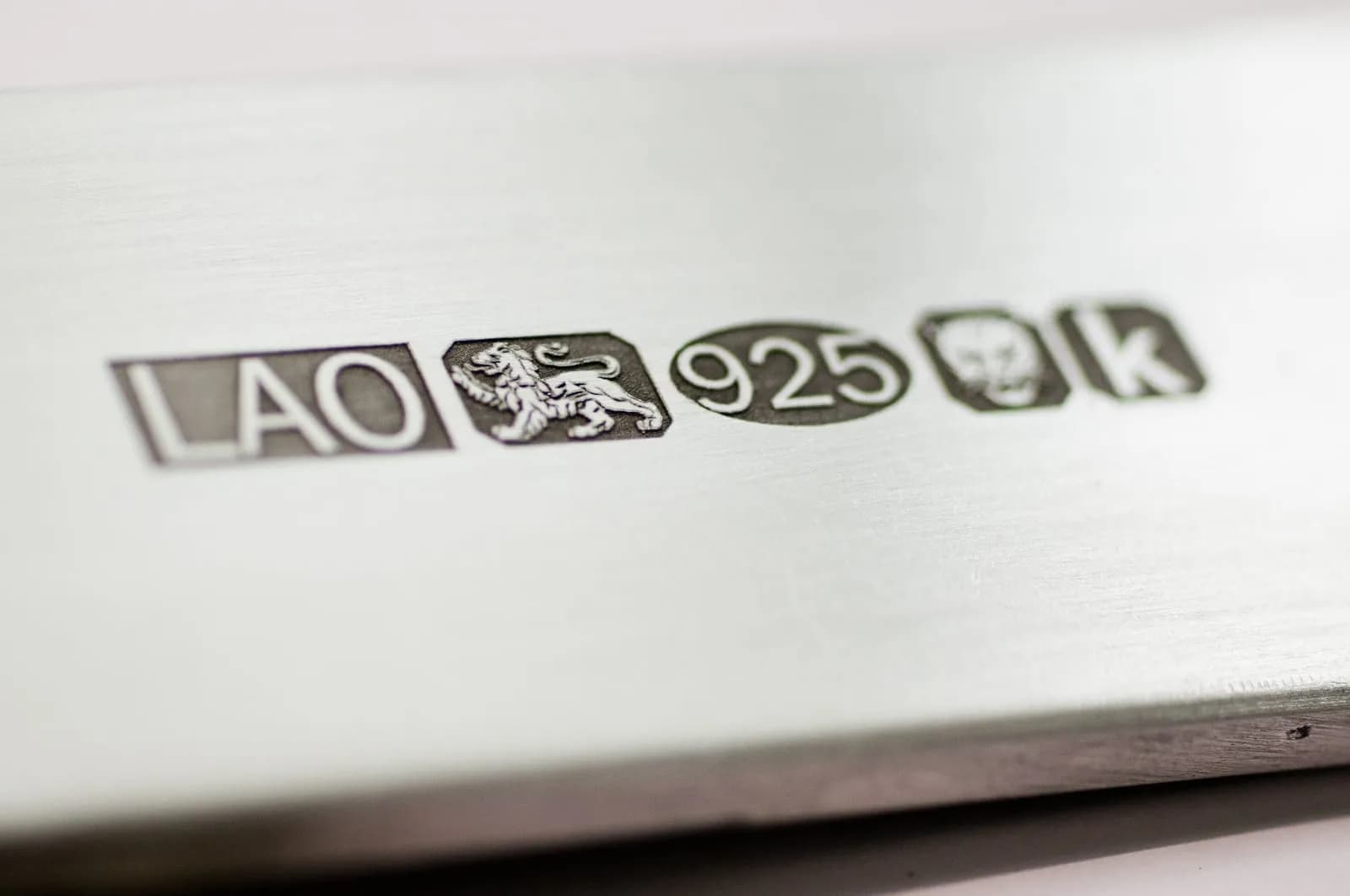
A complete UK hallmark has three compulsory marks, according to gov.uk: the sponsor's mark, the fineness mark and the assay office mark. The date letter and the traditional fineness symbol are optional, though the London Assay Office applies the traditional symbol as standard and lists five marks in a full traditional hallmark. The sponsor's mark establishes who is responsible for the article. It doesn't necessarily identify the maker, because London notes it may be applied to goods made by others.
Each description, with its margin note
Here are the phrases you will meet most often, and what the sources say each one implies about the metal.
Solid gold, 9ct, 18ct. Margin note: the number is parts per thousand. 375 is 9ct, 585 is 14ct, 750 is 18ct (75% gold) and 916 is 22ct. Above the exemption weight it must carry a hallmark before it can be sold as gold. In a mixed-metal article the fineness mark reflects the lowest precious-metal standard, so the whole article is no less than the mark shown, as the London page puts it.
Rolled gold. Margin note: this is the qualifier the Act allows for gold. The qualifying word must be at least as large as the rest of the lettering, so 'rolled' can't be a footnote to a bold 'GOLD'. The word tells you there is a gold layer. It doesn't tell you how thick that layer is, so ask.
Gold plated. Margin note: what may be described as 'gold plate' is the subject of a 1977 notice from the Joint Committee of Assay Offices, published on gov.uk by the British Hallmarking Council. The notice is a one-page scan, and it is where to check the permitted phrasing. F.Hinds says silver-plated items are not hallmarked, and that gold-plated items on silver are hallmarked as sterling silver where applicable. Where that applies, the hallmark describes the base, not the gold on top.
Vermeil, bonded gold, gold-filled. Margin note: F.Hinds lists vermeil, bonded gold and rolled gold as separate categories. Neither vermeil nor gold-filled is among the qualifiers the Act names, and the official guidance listed below doesn't define them. Treat them as the seller's own labels and ask what metal sits underneath and how thick the gold layer is.
Gold colour, gold tone. Margin note: the Act also permits colour-only descriptions. They tell you about appearance and nothing about the metal.

The Dealer's Notice: the key to the marks
Dealers supplying precious-metal items must display a notice explaining approved hallmarks. Dealer's Notice A is for physical shops and Dealer's Notice B is for online retailers. According to gov.uk, online sellers must prominently show the explanatory hallmark information. Notice A has to be black and white and at least A4 portrait, and a free PDF is available.
The notice exists so that a buyer can read, in the shop or on the seller's own site, what the marks on a piece mean. It is standard explanatory wording, not a promise about any one item. It tells you what to look for in the hallmark, and what a particular listing claims is still a question for the seller.

Where the one gram line sits
Small items escape compulsory hallmarking. The exemption weights are gold 1 g, silver 7.78 g, platinum 0.5 g and palladium 1 g. Above them, gov.uk says, selling an unhallmarked item is against the law, in a shop or online.
The wording at the boundary varies. gov.uk says items below the weights are exempt, while F.Hinds says gold articles weighing more than 1 gram must be hallmarked. An item at exactly 1 g is a question for an Assay Office. F.Hinds adds that items below the weights are still guaranteed to meet the minimum fineness for their metal, which is a retailer's statement worth asking about in writing.
A worked example: reading one listing
Take the F.Hinds page for a 9ct white gold D-shaped wedding ring, 4 mm, code R5514. On 15 November 2026 the page showed £299.00, reduced from £350.00, and described the ring as made in the UK. This is a reading of the listing, not of the ring itself.
Read the title against the margin notes. '9ct' means 375 parts per thousand, so 37.5% gold, whatever the colour. 'White' describes the colour of the alloy, not how much gold it contains. F.Hinds says all gold articles over 1 gram must be hallmarked and that its precious-metal products comply with the Act. The sampled page, though, shows no gram weight, no fineness figure and no hallmark statement. It links only to a general hallmarking article. A careful buyer would ask for the weight and the hallmark details before paying.
Weight also decides how much gold is in the piece. Using Trading Economics' over-the-counter figure of 3,881.75 USD per troy ounce on 13 November 2026 (not the LBMA benchmark), pure gold works out at about $124.80 a gram. For an illustrative 5 g piece, chosen for the arithmetic and not the ring's actual weight, 9ct holds 1.875 g of gold, about $234. A 5 g 18ct piece holds 3.75 g, about $468. That is metal value only, before making, stones and retail margin.
Common questions
Is 9ct gold real gold?
Yes. The Act sets 375 parts per thousand as the minimum fineness for gold, and 9ct is exactly that: 37.5% gold, with other metals making up the rest.
Does gold-plated jewellery need a hallmark?
It depends on the base metal and the weight. F.Hinds says silver-plated items are not hallmarked and that gold-plated items on silver are hallmarked as sterling silver where applicable. For a specific piece, check with an Assay Office.
Is vermeil a legally defined term?
Not in the Hallmarking Act. Vermeil and gold-filled are not among the qualifiers the Act names, so ask the seller to state the base metal and the gold layer in writing.
Where can I read what the seller must display?
Dealer's Notice A applies to shops and Dealer's Notice B to online retailers. The gov.uk guidance for businesses explains both.
Sources
- Hallmarking is the law: guidance summary (gov.uk)
- Hallmarking: how businesses can comply with the law (gov.uk)
- Silver plate and gold plate notice (gov.uk)
- Hallmarking Act 1973 (legislation.gov.uk)
- UK hallmarks (London Assay Office)
- Hallmarking (Birmingham Assay Office)
- Hallmarks guide (F.Hinds)
- 9ct White Gold D Shaped Wedding Ring 4mm R5514 (F.Hinds)
- Gold price (Trading Economics)
Read next

HealthBuying guide
“99.99% effective” on the box: reading the footnotes on oral-care claims
Oral-care percentages often rest on a lab test or a narrow comparison. Here is what the ASA and FTC say, what the Cochrane review found, and how to read the footnotes.

TechnologyBuying guide
A drone under the tree: what to register and pass in the UK, EU and US
Got a drone as a present? The UK's 2026 rules, the EU's class marks and the US test and registration, read clause by clause, with a gloss on each.

LifestyleBuying guide
Is there a UK ticket resale cap yet? What's law today and what's still a plan
Is there a legal cap on UK ticket resale prices yet? Official texts show a government plan, not a law in force. Here is what is law today and what is not.