TravelBuying guide
How to Choose a Travel Adapter That Works Almost Everywhere
Most universal adapters cover four plug styles, not every socket. Here is what to check, what to pay for, and which safety problems to avoid.
In this guide7 sections
Why "universal" does not mean every socket
The four-plug block most shoppers buy will not fit every socket on earth. The picks on NBC Select's adapter list cover EU, UK, US and Australian pins, and the top-rated models in BGR's roundup also come with four plug types. Pack Hacker, in a guide updated October 12, 2026, says most of the world uses one of three main styles: the US and Australian family, the UK type, and the two-round-prong European type.
India and South Africa are the usual gaps. World Standards lists Type D and Type M as the standard outlets in India, at 230V and 50Hz, with Type D for small devices and Type M for heavy appliances, and it names South Africa as the main user of Type M. Neither type is on that EU, UK, US and AU list. A European plug is not a reliable workaround: World Standards says Type C plugs only partly fit Type D sockets and that the connection can be unstable and sometimes unsafe. For those trips, plan on a separate single-country adapter.
Treat country counts with care. BGR reports a claim of more than 200 countries for the Epicka Universal, and Pack Hacker reports a claim of more than 150 for the Mingtong. Those numbers tell you less than the pin list does. Look up the plug type for each stop, since some countries, Italy among them, use more than one. Carl Prouty of the retailer Abt told NBC Select to ask your lodging what outlets it has.
The criteria that matter
Once the pins match your route, these are the specs worth comparing.
Named plug coverage: a list of pin types you can check against your itinerary, plus the countries printed on the packaging.
Total USB output: BGR lists 28W total for the Epicka Universal, 70W maximum for the Baseus and a 70W Power Delivery port on the Ceptics 6-in-1. Compare the figure with the wattage printed on your laptop charger.
Shared power: Pack Hacker warns that using every port on the 205W Momax divides the available power, so charging slows.
AC rating: Electrical Safety First says to check an appliance's power draw against the adaptor's maximum rating, shown in amps or watts.
Fuse type: BGR says the Epicka has a 10A fuse and includes a spare, while the Mogics Super Bagel uses an auto-resetting fuse. Pack Hacker says that one usually resets within an hour, though some users report it does not.
Earth connection: Electrical Safety First says some adaptors cannot provide one and should be used only with double-insulated equipment, usually marked with two rectangles.
Size and fit: Pack Hacker calls the Epicka TA-105 Pro large and says the slim CARD model may fall out of some outlets. BGR calls the Baseus bulky and heavy.
Adapters do not change voltage
An adapter changes the pin shape. It does not change the electricity. NBC Select puts North American outlets at 110 to 120V and most other countries at 220 to 240V. BGR says the Epicka, Baseus and Ceptics models are not voltage converters, and NBC Select says the same of its plug adapter picks.
The check takes a minute. Read the rating plate on each device or charger. Electrical Safety First says a dual-voltage item shows a range such as "INPUT: 110-240V" and needs only an adapter. NBC Select says phones, laptops and tablets are usually rated for worldwide voltage, while hair straighteners and curling irons often need a converter.
Heating appliances are the hard case. Sandra Miller, a product manager at the manufacturer Ceptics, told NBC Select that a 200W converter is limited to devices drawing 200W or less, so a 1,500W hair dryer would be too much. NBC Select also suggests choosing a styling tool with a worldwide voltage rating so you can avoid a converter altogether. Electrical Safety First adds that converters and transformers are not suitable for some electronics, including game consoles, TVs, radios and computers, and says to check with the manufacturer if unsure. For medical devices, ask the manufacturer or your care provider before using any adapter or converter.
Safety is the real reason to be picky
Adapters sold through online marketplaces have a documented problem. STV reported on July 28, 2026 that Electrical Safety First bought 14 travel adaptors, eight universal and six basic, from AliExpress, eBay, Amazon Marketplace and TikTok Shop. All 14 failed basic safety tests. In six of the universal models, more than one set of pins could be live at once, exposing users to up to 240 volts. All eight universal models had pins that failed dimensional and strength requirements and could break off inside a socket. The six adaptors put through flammability testing all failed. STV reports that the marketplaces removed the listings.
An earlier investigation, reported by Business Companion, found adaptors labelled with surge protection that had none fitted, and an adaptor advertised as "electric shock proof" with no safety shutters. That one carried Amazon's Choice label. Business Companion also notes that online marketplaces are not currently recognised as supply chain actors, so they have no legal responsibility for the safety of third-party goods sold on their sites.
Electrical Safety First says adaptors sold in the UK must meet BS 8546 and advises buying from a reputable retailer rather than a third-party online seller. Buy before you leave, since it says some adaptors sold abroad do not meet UK standards. If you are outside the UK, the same logic applies: choose a seller you can identify, and treat safety claims in a listing as unproven.
What to pay for and what to skip
Pay for what you will use every day on the trip. Skip the rest, because more ports usually means a bigger block.
Pay for a high-wattage USB-C port if you charge a laptop from the adapter.
Pay for an AC socket only if you carry something that needs one. Pack Hacker notes the Ugreen 65W Nexode has no socket, which suits people who mostly use USB-C.
Pay for a known seller. The safety findings above concern marketplace listings, so a small premium at an established retailer is worth it.
Skip all-in-one models with a built-in converter unless you have checked recent reviews. BGR's two avoid picks, the Zanoal and the Insignia, both include converters, with owner reports of units failing or damaging devices. BGR's ranking rests on Amazon ratings, not lab tests.
Skip very high port counts if you travel alone. Pack Hacker calls the 205W Momax overkill for solo travelers.
Skip the universal block altogether if you visit one region. An individual plug set is smaller, though NBC Select notes loose pieces are easy to lose.
Common mistakes
Most adapter problems come from how the product is used, not which one was bought.
Plugging a 120V single-voltage appliance into a 230V socket through an adapter. Miller told NBC Select this risks damaging the device, burning it out or causing an electrical fire.
Using an adapter like a permanent socket. Ireland's Competition and Consumer Protection Commission says these are meant for short-term use with low-energy devices.
Leaving it in the wall. The same agency says to unplug it when you finish, when you leave your accommodation and before you sleep.
Inserting in the wrong order. It says to connect the appliance to the adaptor first, then put the adaptor into the socket.
Using it in a country not listed on the packaging or safety information.
Assuming every three-pin plug is earthed through the adapter. Check the product's documentation, and use unearthed adaptors only with double-insulated equipment.
Ignoring a fuse that keeps blowing. Electrical Safety First says not to ignore fuses blowing in your accommodation.
Price tiers
Prices below are the ones BGR listed in its February 2026 roundup unless noted. They could not be rechecked at retailers in October 2026, so confirm them before buying.
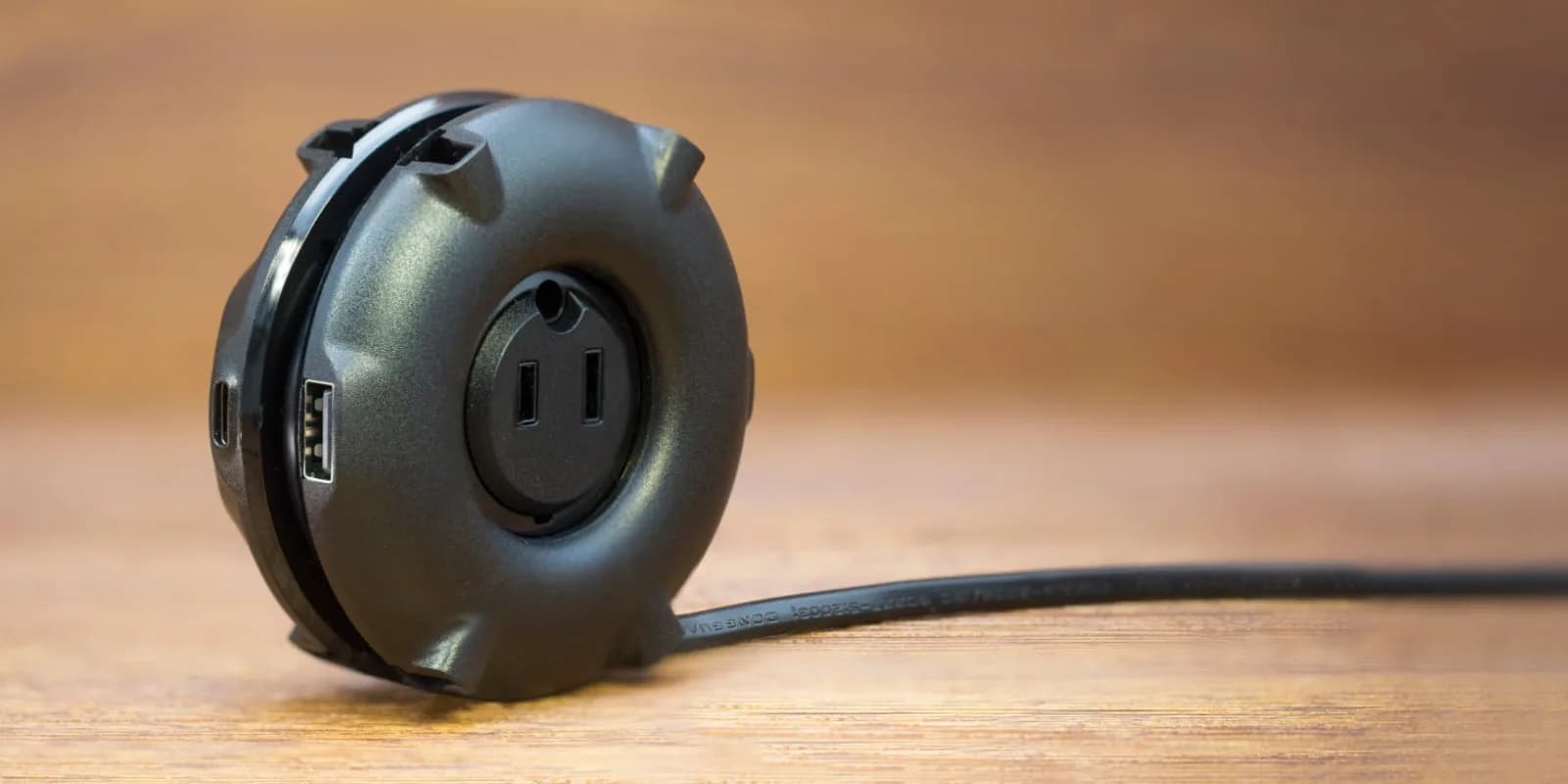
Budget, up to about $25: basic charging for a phone and small devices. The Epicka Universal was around $23 with one USB-C port, four USB-A ports and one AC socket. NBC Select listed the Mingtong Universal at around $14 on a page dated May 2025, with USB-C up to 20W.
Mid-range, about $30 to $40: more charging power. The Rolling Square pocket adapter was around $30, with 30W from a single USB-C port, so it charges one device at a time. The Ceptics 6-in-1 was around $40, with a 70W port and six-device capacity.
Upper, about $50 to $60: laptop charging or several sockets. The Baseus 70W was around $50 with a built-in USB-C cable. The Mogics Super Bagel was around $59, a circular power strip with five sockets that also works as an extension cable, which Pack Hacker names as its best-value pick.
Side by side
| Epicka Universal | Ceptics 6-in-1 | Baseus 70W | Rolling Square Pocket | |
|---|---|---|---|---|
| Price (BGR, Feb 2026) | Around $23 | Around $40 | Around $50 | Around $30 |
| USB power | 28W total | One 70W PD port | 70W maximum | 30W maximum |
| Devices at once | Up to 6 | Up to 6 | Up to 6 | 1 |
| Fuse | 10A, spare included | Not listed by BGR | Dual 10A | Not listed by BGR |
| Noted drawback | Bulkier than a simple plug | No carrying case | Bulky, heavy, warm at maximum power | Single device only |
Common questions
Will a universal adapter run my hair dryer?
Fitting the socket is only half of it. A single-voltage dryer needs a converter rated for its full wattage, and NBC Select cites a 1,500W dryer as too much for a 200W converter. The adapter's own maximum rating also has to cover the draw. A dryer with a worldwide voltage rating needs no converter, only an adapter.
Do I need a voltage converter for my phone or laptop?
Usually not. NBC Select says these devices are generally rated for worldwide voltage. Confirm by reading the charger's label for a range such as 100-240V.
Will a four-plug adapter work in India or South Africa?
Do not count on it. World Standards lists Type D and Type M as India's standard outlets and names South Africa as the main user of Type M. Neither is among the EU, UK, US and AU pins on common four-plug models, so buy a dedicated adapter for those countries.
Can I leave a travel adapter plugged in overnight?
Ireland's Competition and Consumer Protection Commission says to unplug it before you go to sleep and when you leave your accommodation, and calls travel adaptors high-risk electrical products.
Sources
- When travelling - Electrical Safety First
- 'Highly dangerous' travel adaptors found for sale to UK consumers - STV News
- ESF: thousands of dangerous travel adaptors sold online - Business Companion
- Travel adaptors - Competition and Consumer Protection Commission
- 5 Travel Adapters You Should Buy And 2 To Avoid - BGR
- Best Travel Adapter for International Travel - Pack Hacker
- The best travel adapters for the next big trip - NBC Select
- India plug and voltage information - World Standards
Read next

TravelBuying guide
Cruise cover annotated: cabin confinement, missed port and itinerary change
Three cruise clauses read against Avanti's cruise page: what each pays, where versions of the page differ, and the questions to put to the wording first.
TravelBuying guide
Flight cancelled by snow? Six myths about what UK261 still owes you
Snow can cancel your compensation, but not the meals, the hotel or the refund-or-reroute choice. Six winter-delay myths set against the CAA's own wording.

TravelBuying guide
A winter abroad: what to check in a long-stay travel insurance policy first
Before three months away, read the margins: trip-length caps by age, health changes mid-stay, returning home, and what the GHIC does not cover. Annotated, not advised.